Comparison with the Failed June 29, 1973 Coup which
preceded the September 11, 1973 military coup against Salvador Allende
Was it really a military coup?
Anybody who has lived in Caracas, knows that you
cannot wage a spontaneous military coup starting up in Chacaito, an upper
middle class residential area, with a view to eventually marching towards the
Miraflores presidential palace located in the historical centre of Caracas,
without getting caught in dense traffic.
There are important historical precedents of failed
coups caught up in traffic.
Guaido presents the operation as the “Final phase” of
“Operation Freedom.” ???
An attempted coup or violent street riots?
Lopez and Guaido released videos on social media,
calling on the armed forces to back their efforts and urging supporters to take
to the streets, in what they termed as the “final phase” of the so-called
“Operation Freedom.” Large crowds of anti-government protesters, as well
as opposition lawmakers, made their way to the Altamira overpass. (Venezuela
Analysis, May 1, 2019)
The government responded by sending in the riot
police, with the Armed Forces using tear gas against the protesters.
This spontaneous so-called military putsch was meant
to fail.
Visibly, it was not a carefully planned operation. And
Washington was fully aware from the outset that it would fail. In fact it
was carefully staged “not to succeed”:
The scene then saw armed confrontations between the
soldiers that backed Juan Guaido and those inside La Carlota airbase.
[Carlota is not a full-fledged military base, it is a
former private airport, largely defunct. It is now under the jurisdiction of
the State of Miranda, used for both military and civilian emergencies]
According to witnesses in La Carlota [air
base], the Venezuelan armed forces fired tear gas towards the Altamira
overpass, where civilian protesters began to gather, whereas Guaido’s soldiers
returned live fire. Riot police also appeared on the scene to try and
disperse the crowds. There are reports of protesters wounded and arrested that
are unconfirmed at the time of writing.
At the same time, many of the originally deployed
soldiers withdrew from the scene, later revealing that they had been “deceived”
by their superiors. Simultaneously, Chavista leaders took to state and social
media to denounce what they termed a coup in progress, and large crowds
gathered to defend Miraflores Presidential Palace.
Guaido later attempted to lead a march, including some
armed soldiers, into western Caracas but was stopped by Venezuelan
National Guard forces in Chacaito, some 10 kilometers away from
Miraflores.(Venezuela Analysis, May 1, 2019)
From Washington’s standpoint, the ‘putsch” nonetheless
served a “useful” purpose. It created a “narrative”, which serves as propaganda
and media disinformation. In turn, the Western media goes into high gear.
The “coup” becomes a talking point for the Bolton
-Pompeo national security team. It becomes a pretext and a justification for US
military intervention in the name of Democracy at some future date. See Pompeo
below
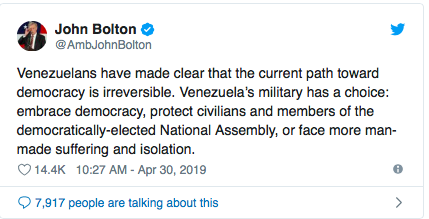
National security Advisor John Bolton calls
upon Venezuela’s military to intervene, with US support.
Mild thunder before the storm? It sets the stage? What
is the intended timeline?
A failed putsch which may be followed by a “real” US
sponsored military coup at some later date? That option is already on the
drawing-board of the Pentagon.
The failed coup, a sloppy intelligence operation?
Unlikely. US intelligence was fully informed.
Was this event planned to fail from the very outset?
………
An Important Historical Precedent, Santiago
de Chile. The Failed June 29, 1973 Coup
In Chile in 1973, the September 11 coup d’Etat which
led to the assassination of Allende and the installation of a military
government was a carefully prepared military-intelligence operation supported
by the US. with Henry Kissinger playing a key role.
Of historical significance: The September 11, 1973
coup was preceded by a failed coup on June 29, 1973 , which, in retrospect, was
intended to fail.
Bear in mind: The circumstances of Chile in 1973
as well as the command structure of the (Chilean) Armed Forces were very
different to those of Venezuela in 2019.
In the course of the months of July-August 1973,
following the June 29, 1973 failed coup, important shifts occurred within
Chile’s Armed Forces.In turn, the Christian Democrats were pressuring Allende
to bring the military into the government.
Chile: The June 29, 1973 Failed Coup
On June 29, 1973, Coronal Roberto Souper led
his tank division in an isolated attack on La Moneda, the Presidential Palace,
in the hope that other units of the armed forces would join in. The June coup
had initially been planned for the morning of September 27 by Patria y Libertad
as well as by several high ranking military officers. The plans were found out
by Military Intelligence and the coup was called off at 6pm on the 26th. A
warrant for the arrest of Coronal Souper had been issued. Confronted with
knowledge of his impending arrest, Colonel Souper in consultation with the
officers under his command, decided to act in a most improvised fashion. At 9
am, amidst morning rush hour traffic, Tank Division Number Two drove down
Bernardo O’Higgins, Santiago’s main down-town avenue towards the Presidential
Palace.
While the aborted June Coup had the appearance of an
insolated and uncoordinated initiative, there was evidence of considerable
support in various sectors of the Navy as well as from Air Force General
Gustovo Leigh, now [September 1973] member of the military junta [on 11
September General Leigh integrated the military Junta headed by General
Pinochet]. According to well-informed sources, several high ranking officers in
the aero-naval base of Quintero near Valparaiso had proposed the bombing of
State enterprises controlled by militant left wing groups, as well as the
setting up of an air corridor to transport navy troops. The latter were slated
to join up with the forces of Colonel Souper in Santiago.
The June trial coup was «useful» indicating to the
seditious elements within the Chilean Armed Forces that an isolated and
uncoordinated effort would fail. After June 29, the right-wing elements in the
Navy and the Air Force were involved in a process of consolidation aimed at
gaining political support among officers and sub-officers. The Army, however,
was still under the control of Commander in Chief General Carols Prats, who had
previously integrated Allende’s cabinet and who was a firm supporter of
constitutional government.
Meanwhile in the political arena, the Christian
Democrats were pressuring Allende to bring in members of the Military into the
Cabinet as well as significantly revise the programme and platform of the
Unidad Popular. Party leaders of the government coalition considered this
alternative [proposed by the Christian democrats] as a « legalized military
coup» (golpe legal) and advised Allende to turn it down. Carlos Altamirano,
leader of the Socialist Party had demanded that an endorsement of the programme
of the Popular Unity coalition by the military be a sina qua non condition for
their entry into the Cabinet. Upon the impossibility of bringing in the
Military into the Cabinet on acceptable terms, Allende envisaged the formation
of a so-called “Cabinet of Consolidation” composed of well known
personalities. Fernando Castillo, rector of the Catholic University and a
member of the Christian Democratic Party, Felipe Herrera, President
of the Inter-|American Development Bank and other prominent personalities were
approached but declined. (Michel Chossudovsky, The Ingredients of a
Military Coup, Universidad Catolica de Chile, Santiago,
September 1973)
Minor
edits to this text on May 1-2, 2019
The
original source of this article is Global Research